 Free Shipping
 Made In USA

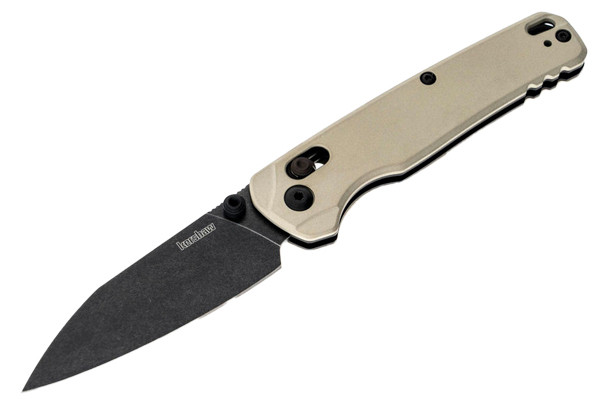
The Kershaw Bel Air brings CPM MagnaCut to Kershaw's USA made lineup at a price that makes premium steel easy to reach. Kershaw runs the blade at 62 to 64 HRC, where MagnaCut delivers the toughness and corrosion resistance it is known for, holding an edge on par with S35VN and S45VN while staying tougher and easier to sharpen than M390. Our comparison of every major knife steel shows how it stacks up. Slim, bearing equipped, and built to work, the Bel Air has become one of the defining models in the full line of Kershaw knives.
The reverse tanto Bel Air runs 3.1 inches with a reinforced tip built for piercing and controlled cuts. The clip point Bel Air at 3.05 inches carries a curved edge suited to slicing and detail work. Both ride on KVT ball bearings for smooth, drop shut action, and Damascus versions of each, like the 6106DAM, swap MagnaCut for a patterned blade.
Kershaw's DuraLock is a crossbar style lock that uses a steel bar to block the blade from closing until you pull it back. It works the same for either hand, uses few moving parts, and locks up solid. Our guide to knife lock types explains how it compares to a framelock or liner lock.
Reverse tanto models come in anodized aluminum, marbled carbon fiber, or G-10, and clip points add green canvas Micarta. The carbon fiber version weighs about 2.5 ounces and aluminum about 2.9. The newest Bel Air Kings Camo bonds the XK7 camo pattern directly to the aluminum. Every model carries a reversible deep carry clip for tip up carry. Our guide to knife handle materials breaks down the options.
The Bel Air XL stretches the blade to 3.4 inches on thicker 0.125 inch stock for heavier cutting, and it closes to about 4.5 inches, still easy to pocket at around 3.1 ounces. The black G-10 XL runs MagnaCut, the FDE XL steps up to M4, and the olive XL runs tough CPM 3V. The Bel Air XL EMT turns the platform into a rescue tool with a blunt tip, a partially serrated 3.25 inch blade for seatbelts and clothing, and a carbide glass breaker, in black or orange.
Free Shipping Made In USA